RNA
integrity (1)
RNA integrity (2) RNA integrity (3) RNA integrity (3) RNA integrity & DNA integrity (4) RNA integrity -- latest papers (5) RNA secondary structure (6)
OVERVIEW
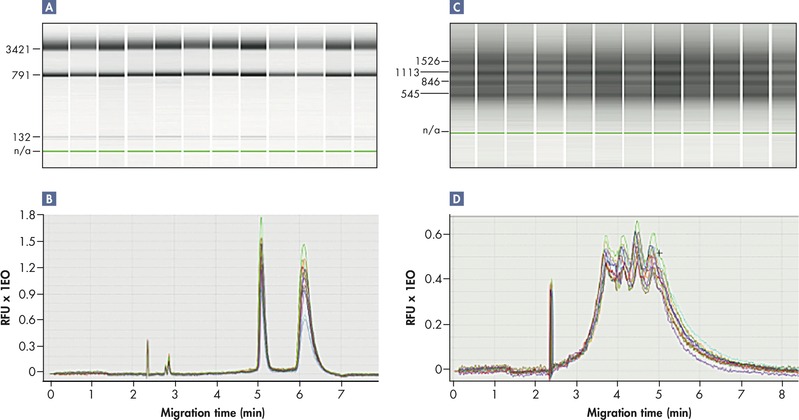
REVIEW: RNA integrity and the effect on the real-time qRT-PCR performance. Molecular Aspects of Medicine 27 (2006) 126–139 Simone Fleige & Michael W. Pfaffl Physiology Weihenstephan, Center of Life and Food Sciences (ZIEL), Technical University of Munich, 85350 Freising, Germany TATAA Biocenter Germany, Freising-Weihenstephan, Germany The assessment of RNA integrity is a critical first step in obtaining meaningful gene expression data. Working with low-quality RNA may strongly compromise the experimental results of downstream applications which are often labour-intensive, time-consuming, and highly expensive. Using intact RNA is a key element for the successful application of modern molecular biological methods, like qRT-PCR or micro-array analysis. To verify RNA quality nowadays commercially available automated capillary-electrophoresis systems are available which are on the way to become the standard in RNA quality assessment. Profiles generated yield information on RNA concentration, allow a visual inspection of RNA integrity, and generate approximated ratios between the mass of ribosomal sub-units. In this review, the importance of RNA quality for the qRT-PCR was analyzed by determining the RNA quality of different bovine tissues and cell culture. Independent analysis systems are described and compared (OD measurement, NanoDrop, Bioanalyzer 2100 and Experion). Advantage and disadvantages of RNA quantity and quality assessment are shown in performed applications of various tissues and cell cultures. Further the comparison and correlation between the total RNA integrity on PCR performance as well as on PCR efficiency is described. On the basis of the derived results we can argue that qRT-PCR performance is affected by the RNA integrity and PCR efficiency in general is not affected by the RNA integrity. We can recommend a RIN higher than five as good total RNA quality and higher than eight as perfect total RNA for downstream application. Our RNA integrity basis paper has been frequently cited by other researchers: mRNA and microRNA quality control for
RT-qPCR analysis
Becker C, Hammerle-Fickinger A, Riedmaier I, Pfaffl MW. Physiology-Weihenstephan, Technical University Munich, Freising, Germany. Methods. 2010 50(4): 237-243 The importance of high quality sample material, i.e. non-degraded or fragmented RNA, for classical gene expression profiling is well documented. Hence, the analysis of RNA quality is a valuable tool in the preparation of methods like RT-qPCR and microarray analysis. For verification of RNA integrity, today the use of automated capillary electrophoresis is state of the art. Following the recently published MIQE guidelines, these pre-PCR evaluations have to be clearly documented in scientific publication to increase experimental transparency. RNA quality control may also be integrated in the routine analysis of new applications like the investigation of microRNA (miRNA) expression, as there is little known yet about factors compromising the miRNA analysis. Agilent Technologies is offering a new lab-on-chip application for the 2100 Bioanalyzer making it possible to quantify miRNA in absolute amounts [pg] and as a percentage of small RNA [%]. Recent results showed that this analysis method is strongly influenced by total RNA integrity. Ongoing RNA degradation is accompanied by the formation of small RNA fragments leading to an overestimation of miRNA amount on the chip. Total RNA integrity is known to affect the performance of RT-qPCR as well as the quantitative results in mRNA expression profiling. The actual study identified a comparable effect for miRNA gene expression profiling. Using a suitable normalization method could partly reduce the impairing effect of total RNA integrity. mRNA and microRNA Purity and Integrity: The Key to Success in Expression Profiling Benedikt Kirchner, Vijay Paul, Irmgard Riedmaier and Michael W. Pfaffl Chapter 5 -- in Quantitative Real-Time PCR: Methods and Protocols (Methods in Molecular Biology) by Roberto Biassoni, Alessandro Raso RNA quality control is a crucial step in guaranteeing integer nondegraded RNA and receiving meaningful results in gene expression profiling experiments, using micro-array, RT-qPCR (Reverse-Transcription quantitative PCR), or Next-Generation-Sequencing by RNA-Seq or small-RNA Seq. Therefore, assessment of RNA integrity and purity is very essential prior to gene expression analysis of sample RNA to ensure the accuracy of any downstream applications. RNA samples should be nondegraded or fragmented and free of protein, genomic DNA, nucleases, and enzymatic inhibitors. Herein we describe the current state-of-the-art RNA quality assessment by combining UV/Vis spectrophotometry and microfl uidic capillary electrophoresis. Comparison of relative mRNA quantification models and the impact of RNA integrity in quantitative real-time RT-PCR. Fleige S, Walf V, Huch S, Prgomet C, Sehm J, Pfaffl MW. Physiology Weihenstephan, Center of Life and Food Sciences (ZIEL), Technical University Munich, Germany. Biotechnol Lett. 2006 28(19): 1601-1613 Relative quantification in quantitative real-time RT-PCR is increasingly used to quantify gene expression changes. In general, two different relative mRNA quantification models exist: the delta-delta Ct and the efficiency-corrected Ct model. Both models have their advantages and disadvantages in terms of simplification on the one hand and efficiency correction on the other. The particular problem of RNA integrity and its effect on relative quantification in qRT-PCR performance was tested in different bovine tissues and cell lines (n = 11). Therefore different artificial and standardized RNA degradation levels were used. Currently fully automated capillary electrophoresis systems have become the new standard in RNA quality assessment. RNA quality was rated according the RNA integrity number (RIN). Furthermore, the effect of different length of amplified products and RNA integrity on expression analyses was investigated. We found significant impact of RNA integrity on relative expression results, mainly on cycle threshold (Ct) values and a minor effect on PCR efficiency. To minimize the interference of RNA integrity on relative quantification models, we can recommend to normalize gene expression by an internal reference gene and to perform an efficiency correction. Results demonstrate that innovative new quantification methods and normalization models can improve future mRNA quantification. Our second RNA integrity basis paper has been frequently cited by other researchers: http://Scholar.Google.com/ Measurable impact of RNA quality on gene expression results from quantitative PCR. Vermeulen J, De Preter K, Lefever S, Nuytens J, De Vloed F, Derveaux S, Hellemans J, Speleman F, Vandesompele J. Nucleic Acids Res. 2011 39(9): e63 Compromised RNA quality is suggested to lead to unreliable results in gene expression studies. Therefore, assessment of RNA integrity and purity is deemed essential prior to including samples in the analytical pipeline. This may be of particular importance when diagnostic, prognostic or therapeutic conclusions depend on such analyses. In this study, the comparative value of six RNA quality parameters was determined using a large panel of 740 primary tumour samples for which real-time quantitative PCR gene expression results were available. The tested parameters comprise of microfluidic capillary electrophoresis based 18S/28S rRNA ratio and RNA Quality Index value, HPRT1 5'-3' difference in quantification cycle (Cq) and HPRT1 3' Cq value based on a 5'/3' ratio mRNA integrity assay, the Cq value of expressed Alu repeat sequences and a normalization factor based on the mean expression level of four reference genes. Upon establishment of an innovative analytical framework to assess impact of RNA quality, we observed a measurable impact of RNA quality on the variation of the reference genes, on the significance of differential expression of prognostic marker genes between two cancer patient risk groups, and on risk classification performance using a multigene signature. This study forms the basis for further rational assessment of reverse transcription quantitative PCR based results in relation to RNA quality.  RNA degradation compromises the reliability of microRNA expression profiling David Ibberson, Vladimir Benes, Martina U Muckenthaler and Mirco Castoldi Genomics Core Facility, EMBL, Meyerhofstraße 1 D-69117 Heidelberg, Germany; Department of Pediatric Oncology, Hematology and Immunology, University of Heidelberg, Im Neuenheimer Feld 156, D-69120, Heidelberg, Germany; Molecular Medicine Partnership Unit, Im Neuenheimer Feld 156, D-69120, Heidelberg, Germany BMC Biotechnology 2009 MicroRNAs are small non-coding RNAs that post-transcriptionally regulate gene expression and their expression is frequently altered in human diseases, including cancer. To correlate clinically relevant parameters with microRNA expression, total RNA is frequently prepared from samples that were archived for various time periods in frozen tissue banks but, unfortunately, RNA integrity is not always preserved in these frozen tissues. Here, we investigate whether experimentally induced RNA degradation affects microRNA expression profiles. Tissue samples were maintained on ice for defined time periods prior to total RNA extraction, which resulted in different degrees of RNA degradation. MicroRNA expression was then analyzed by microarray analysis (miCHIP) or microRNA-specific real-time quantitative PCR (miQPCR). Our results demonstrate that the loss of RNA integrity leads to in unpredictability of microRNA expression profiles for both, array-based and miQPCR assays. MicroRNA expression cannot be reliably profiled in degraded total RNA. For the profiling of microRNAs we recommend use of RNA samples with a RNA integrity number equal to or above seven. Correcting false gene expression measurements from degraded RNA using RT-qPCR. Matthias Port, Hans Ulrich Schmelz, Tanja Stassen, Kerstin Mueller, Marcus Stockinger, Richard Obermair & Michael Abend Bundeswehr Institute of Radiobiology, Munich; Department of Hematology and Oncology, Hannover Medical Department of Urology, Federal Armed Forces Hospital, Koblenz; Institute of Veterinary Pathology, LMU, Munich, Germany. Diagn Mol Pathol 2007 (16): 38–49 This paper describes a method allowing correcting false gene expression measured on highly degraded RNA using real-time quantitative reverse transcription-polymerase chain reaction (RT-qPCR). RNA was isolated from different models (in vitro cell lines, in vivo models of human and dog) and different tissue types. In vitro RNA degradation and modeling of in vivo degradation were applied on intact and degraded total RNA. Gene expression (eg, Bcl-2, GAPDH, PGK, PSME3, RAB2, BAX) was measured using RT-qPCR. 18S rRNA proved to be the most constant house-keeping gene. Less than 10-fold degraded RNA can be quantified correctly when using 18S rRNA for normalization purposes. Higher-fold degraded RNA can be quantified correctly up to a precision that is comparable to RTQ-PCR measurements on intact RNA when simulating the RNA-species and tissue-specific degradation kinetic. Validation
of extraction methods for total RNA and miRNA from bovine blood prior
to quantitative gene expression analyses.
Hammerle-Fickinger A, Riedmaier I, Becker C, Meyer HH, Pfaffl MW, Ulbrich SE. Biotechnol Lett. 2010 32(1): 35-44 Supplement - Biotechnol Lett. 2010 32(1): 35-44 Physiology Weihenstephan, Technische Universitaet Muenchen, Weihenstephaner Berg 3, 85354, Freising, Germany. The benefit and precision of blood diagnosis by quantitative real-time PCR (qPCR) is limited by sampling procedures and RNA extraction methods. We have compared five different RNA extraction protocols from bovine blood regarding RNA and miRNA yield, quality, and most reproducible data in the qRT-PCR with the lowest point of quantification. Convincing results in terms of highest quantity, quality, and best performance for mRNA qPCR were obtained by leukocyte extraction following blood lysis as well as extraction of PAXgene stabilized blood. The best microRNA qPCR results were obtained for samples extracted by the leukocyte extraction method. Einfluss der RNA Integrität auf die quantitative real-time RT-PCR (in German) Simone Fleige & Michael W. Pfaffl (2007) Laborwelt, 2007 (5): 27-29, ISSN 1611–0854, (Editor: T. Gabrielczyk) Lehrstuhl für Physiologie, ZIEL, Technische Universität München, 85354 Freising Die mRNA Quantifizierung via real-time RT-PCR (qRT-PCR) findet heute Anwendung in einer Vielzahl der molekularbiologisch orientierten Labore. Die Methode birgt allerdings – gerade im Bereich der Prä-Analytik – zahlreiche Fehlerquellen. Vor allem die Messung der RNA Qualität führt bis dato noch ein Schattendasein. Das führt häufig zu ungenauen Ergebnissen oder zu erheblichen Variationen in den Expressionsergebnissen. Die Optimierung und Standardisierung der prä- und post-PCR stellen somit eine besondere Herausforderungen bei meiner validen mRNA Quantifizierung dar. Einmal mehr zeigt sich die Gesetzmäßigkeit, dass die Präzision der mRNA Genexpressionsanalyse durch die Quantität und Qualität des Ausgangsmaterials, der total RNA, signifikant beeinflusst wird. Die größte Verbesserung verspricht die Optimierung der Probenaufbereitung und die Bestimmung der RNA-Integrität, sowie die verbesserte Verrechung der erhaltenen real-time RT-PCR Daten. Comparison of two available platforms for determination of RNA quality I. Riedmaier, M. Bergmaier and M.W. Pfaffl Technische Universitat Munchen, Physiology Weihenstephan, Freising, Germany Biotechnol. & Biotechnol. Eq. 2010, 24(4): 2154-2159 The integrity of RNA is a very critical aspect regarding downstream RNA based quantitative analysis like RT-qPCR. Low-quality RNA can compromise the results of such experiments. Today automated lab-on-chip capillary electrophoresis allows rapid RNA quality and quantity determination, e.g. 2100 Bioanalyzer (Agilent Technologies) and the Experion (Bio-Rad). Both platforms determine RNA quality using a numerical system which represents the integrity of RNA. The Bioanalyzer offers the RIN algorithm (RNA Integrity Number) on the Bioanalyzer 2100 and Bio-Rad developed a new Experion software version that offers an algorithm for calculating the RNA Quality Index (RQI).The aim of this study was to compare both systems regarding sensitivity, reproducibility, linearity and the influence of individual tissue extractions and different chip runs on RNA quality and quantity determination.Overall it was confirmed that both algorithms are very comparable and beneficial for the determination of RNA quality for downstream applications. The Experion showed slightly better results regarding reproducibility and absolute sensitivity, whereas the 2100 Bioanalyzer showed a higher linearity. MIQE Guidelines RNA Qualitätskontrolle in der Genexpressionsanalytik (in German) Christiane Becker, Irmgard Riedmaier, Michael W. Pfaffl BIOspektrum - Special RNA Technologien 2009 (5): 512 - 515 Abstrakt (D) - Die Qualität des Probenmaterials, also der Gesamt-RNA, hat einen markanten Einfluss auf die Richtigkeit der quantitativen RT-PCR. Die Überprüfung der RNA Qualität vor einer Expressionsmessung ist unabdingbar, um verlässliche RT-qPCR Expressionsergebnisse zu erhalten. Abstract (E) - The integrity of total RNA has a distinct influence on the accuracy of RT-qPCR. Quality assessment is an essential step for the evaluation of reliable results in gene expression analysis. 
|
||||||||||||||||||||||||||||||||||